



Egg donation is a medical process that allows intended parents to build their family using donated eggs.
While the journey involves several steps, one part often raises the most questions for potential donors: how eggs are actually extracted for donation.
This guide walks you through the egg donation process, with a step-by-step look at what happens before, during, and after egg retrieval. You’ll learn how donors prepare for the procedure, how eggs are extracted, what the day of retrieval looks like, and what recovery typically involves.
As the first egg donation agency in the country, we’re often asked about the egg retrieval process and what to expect. Here’s everything to know about the egg retrieval process!
What Does The Egg Donation Process Look Like?
The egg donation process follows a clear medical timeline designed to keep donors safe, supported, and informed at every stage. While each journey is personalized, most egg donation cycles include the same core steps.
Here’s a high-level overview of how egg donation works:
1. Application and Screening
Prospective egg donors begin by completing an application and medical screening. This typically includes health history reviews, lab work, ultrasounds, and psychological evaluations to ensure it’s safe to move forward.
2. Matching and Clinic Coordination
Once approved, donors are matched and coordinated with a fertility clinic. The medical team creates a personalized treatment plan and schedules monitoring appointments.
3. Hormone Medications and Monitoring
Donors take fertility medications for a short period to help the ovaries mature multiple eggs in one cycle.
During this time, clinics closely monitor hormone levels and follicle development to prepare for retrieval.
4. Eggs Are Extracted for Donation
When the eggs are ready, they’re extracted for donation during a minor outpatient procedure called egg retrieval.
During egg retrieval, a physician uses ultrasound guidance to extract mature eggs from the ovaries while the donor is under light sedation. The procedure itself is brief, and donors typically go home the same day.
Once removed, fertility clinics can fertilize your eggs with sperm to create embryos, then transfer those embryos into the intended mother or surrogate’s uterus. The number of eggs produced depends on many factors, including your age and ovarian reserve.
5. Recovery and Follow-Up
After retrieval, donors rest and recover while the medical team provides aftercare guidance. Most donors return to normal activities within a few days.

What to Expect Before Your Egg Retrieval Procedure
Before your egg retrieval, your egg donation agency and fertility doctor will prepare you with everything you need for the upcoming procedure. This includes all of your appointments, travel logistics, medication administration, and anything else necessary to set you up for an excellent retrieval procedure.
Note that you’ll have appointments leading up to the egg retrieval. This may include, but is not limited to, ultrasounds and bloodwork to determine the number and size of follicles present in your ovaries. Your pre-retrieval treatment will be crafted by your doctor uniquely for you, so every plan looks different.
Timing is everything when it comes to your egg retrieval procedure. You’re ready for your egg retrieval when:
- your leading follicles reach 18 - 20 mm (average diameter) in size
- your estradiol hormone (E2) level increases
When this occurs, your doctor will advise you or your partner to self-administer the human chorionic gonadotropin (hCG) injections in the evenings, between seven and 11 at night.
Thirty-six hours after the hCG injection, your doctor will schedule the egg retrieval procedure. If you self-administer the injections on a Monday at 9:00 PM, the egg retrieval procedure will occur on Wednesday at 9:00 AM.
Note: the evening before your egg retrieval, please abstain from any food or beverages after midnight.
How Do Doctors Extract Eggs for Donation?
Eggs are extracted for donation during a short medical procedure called egg retrieval.
While it may sound intimidating, egg retrieval is a routine part of the egg donation process and typically takes less than 30 minutes.
Below is a step-by-step look at how egg extraction works.
1. Final Monitoring and Trigger Shot
In the days leading up to retrieval, your clinic monitors follicle growth through ultrasounds and bloodwork. Once the eggs are mature, you’ll receive a “trigger shot” to help the eggs reach their final stage of development. Egg retrieval is scheduled about 36 hours later.
2. Arrival at the Clinic
On the day of the procedure, you’ll arrive at the fertility clinic and check in. You’ll change into a gown, and the medical team will review the procedure and answer any last questions.
3. Light Sedation
Before egg extraction begins, you’ll receive light IV sedation or anesthesia so you’re comfortable and relaxed. Most donors are asleep or very drowsy during the procedure and don’t feel pain.
4. Ultrasound-Guided Egg Extraction
Using a transvaginal ultrasound, the physician guides a thin needle through the vaginal wall and into each ovary. The needle gently aspirates (suction removes) the fluid from each follicle, which contains the eggs.
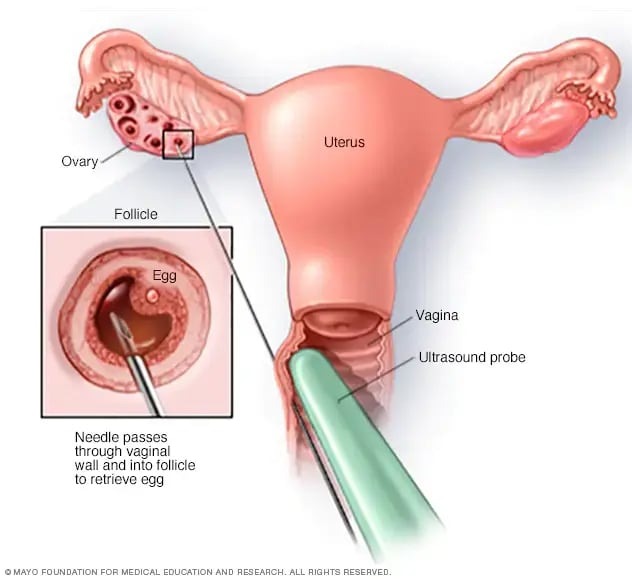
An embryologist examines the fluid in the lab to identify and collect the eggs.
5. Recovery Room Monitoring
After the eggs are extracted, you’ll rest in a recovery area while the sedation wears off. Medical staff monitor you briefly to ensure you’re feeling well before you’re discharged.
Most donors go home the same day and are advised to rest for the remainder of the day.
You may feel some levels of discomfort for a few hours following the egg retrieval. To combat this, you can take Tylenol (acetaminophen) as needed every four hours. If you feel nauseous, this should dissipate within a few hours.
Some donors will notice a slight increase in their weight days after egg retrieval, usually resulting from water retention and other factors. However, if you gain more than five pounds, call your doctor immediately. Ten to twelve days after the egg retrieval procedure, you should start your period.
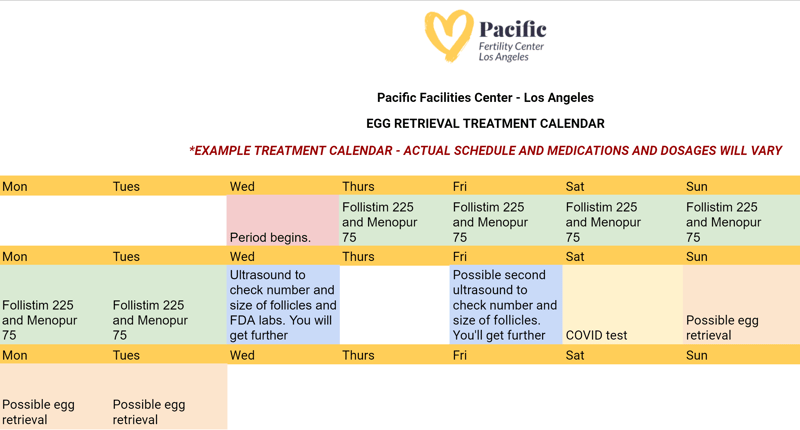
Egg Retrieval Calendar Example
Below is a templated example of what your egg retrieval treatment calendar may look like. Please note that the medications and schedule will vary depending on your unique treatment plan.
Is Egg Extraction Painful?
For most egg donors, egg extraction is not painful during the procedure itself. This is because egg retrieval is performed under light IV sedation or anesthesia, so donors are asleep or very relaxed and don’t feel the eggs being extracted.
After the procedure, it’s normal to experience mild to moderate discomfort, which can include:
- Cramping similar to period cramps
- Abdominal bloating or pressure
- Light spotting
These symptoms usually peak within the first 24 hours and improve over the next few days.
Most donors describe post-retrieval discomfort as manageable and short-lived, especially with rest and over-the-counter pain relief recommended by their clinic.
Severe pain is uncommon, and your medical team will give you clear instructions on what’s normal and when to call the clinic.
It’s also worth noting that everyone’s experience is different. Factors like how many eggs are retrieved and how your body responds to hormone medications can affect how you feel afterward.
Become an Egg Donor
The egg retrieval procedure is one of many steps on your path to help others make their dreams of a family come true. If you’re interested in starting your journey, we encourage you to apply today.
Egg Extraction FAQs
How long does egg extraction take?
The egg extraction procedure itself usually takes 15 to 30 minutes. Including check-in, preparation, and recovery time, most donors spend a few hours at the clinic and go home the same day.
How many eggs are typically extracted for donation?
The number of eggs retrieved varies from donor to donor. Most cycles result in multiple eggs being extracted, depending on factors like age, ovarian reserve, and how the body responds to fertility medications. Your clinic can give you more personalized expectations during monitoring.
Can egg extraction affect future fertility?
No. Egg extraction does not reduce long-term fertility. The eggs retrieved during donation are eggs that would otherwise be lost during a normal menstrual cycle. Donating eggs does not deplete your overall egg supply.
What happens if not all follicles contain eggs?
It’s normal for some follicles to be empty. During egg extraction, the medical team aspirates each follicle, and an embryologist examines the fluid to identify eggs. Not every follicle will contain a mature egg, and this is expected.
How soon can I return to normal activities after egg extraction?
Most donors return to light activities within one to two days. Your clinic may recommend avoiding strenuous exercise or sexual activity for a short period while your ovaries recover.
Is egg extraction considered a surgery?
Egg extraction is a minor outpatient medical procedure, not major surgery. It’s minimally invasive, performed under sedation, and does not involve incisions or stitches.
When should I call the clinic after egg extraction?
You should contact your clinic if you experience severe pain, heavy bleeding, rapid weight gain, shortness of breath, or symptoms that worsen instead of improving. Your care team will provide clear aftercare instructions and warning signs to watch for.